

 Current position > Product detail
『Saturated Steam Measurement: Why A Vortex Flow Meter Is The Industry Standard』Related information(v cone flow meter|rotary gas meter|gallon meter|gear meter|metal tube rotameter|glass tube rotameter|nutating disk meter|transit time ultrasonic flow meter|wedge flow meter|pd meters|hydraulic flow meter|ultrasonic water flow meter|water flow meter|air flow meter|magnetic water flow meter|oxygen flow meter|gas flow meter|argon flow meter|air velocity meter|gasoline flow meter|fuel flow meter|ultrasonic water meter|digital water meter|nitrogen flow meter|solid flow meter|Oxygen tank flow meter|digital water flow meter|diesel fuel flow meter|steam flow meter|02 flow meter|compressed air flow meter|oil flow meter|liquid flow meter)
Saturated Steam Measurement: Why A Vortex Flow Meter Is The Industry Standard
Quick Answer: A vortex flow meter handles the temperature, pressure, and wetness swings of saturated steam better than orifice plates or differential pressure devices. It has no moving parts, needs less straight pipe, and delivers a 4-20 mA HART signal with built-in density compensation. For plants in Thailand, Vietnam, Nigeria, or Mexico running boilers between 6 and 25 bar, Silver Instruments recommends a vortex meter with an integrated PT100 and pressure sensor as the first choice.
Steam Measurement Is Not a One-Size Job
Saturated steam carries latent heat energy. Measuring its mass flow accurately decides how a boiler house accounts for fuel costs. We have seen this on customer sites many times. A refinery in Indonesia installs a turbine meter, runs it for six months, then calls us because the bearing wear throws readings off by 8 percent. An offset printing plant in Egypt uses an orifice plate and a DP transmitter. The impulse lines clog with condensate every three weeks. These are not rare incidents. They are the normal result of picking a flow technology not built for wet, saturated steam.
Vortex flow meters solved this problem in the 1990s. Since then, they have become the default recommendation from engineering firms that build co-generation plants, textile factories, palm oil mills, and dairy processing lines. The physics is simple. A bluff body sheds alternating vortices downstream. The shedding frequency is linear to flow velocity over a wide Reynolds number range. No gas or liquid compensation curve is needed beyond the basic density input. A sensor sealed behind a stainless diaphragm reads the frequency, and the transmitter converts it to kg/h or lb/hr.
Why Saturated Steam Breaks Other Meters
Saturated steam at 10 bar has a temperature of about 184 °C. As it travels through a DN100 pipe, it loses heat and forms a thin layer of condensate along the pipe wall. That liquid layer introduces a two-phase condition right at the meter. Orifice plates erode fast under wet steam. The sharp edge rounds off within months, and the discharge coefficient shifts. Turbine meters have bearings that need dry, clean steam. Condensate droplets hit the rotor like a water hammer and destroy the thrust pads.
Vortex meters are different. The shedder bar sits in the core of the flow. A light condensate film on the pipe wall does not change the frequency signal. The piezoelectric or differential capacitance sensor inside the meter body stays isolated from the process. Silver Instruments vortex flow meters use a fully welded sensor housing rated to 350 °C, so a short-term steam temperature spike, like 220 °C during boiler start-up, will not kill the sensor. In practice, most engineers skip this part when comparing datasheets, but it is the difference between a meter that lasts five years and one that fails right after the warranty ends.
Built-In Temperature and Pressure Compensation Matters
A vortex meter gives a velocity signal. To get mass flow (kg/h), the transmitter needs density. Saturated steam density changes a lot with pressure. At 6 bar, density is roughly 3.17 kg/m³. At 15 bar, it jumps to 7.66 kg/m³. If your boiler load changes and pressure swings from 8 bar to 12 bar, a velocity-only output makes the control room think steam flow has dropped, when in fact the density increased. That misleads the energy balance.
Here is the thing. Silver Instruments offers vortex flow meters with an integrated PT100 RTD and a pressure transmitter in the same meter body. A single 4-20 mA loop can output mass flow directly. The internal flow computer reads the live temperature and pressure, looks up the saturated steam table stored in firmware, and computes the real-time density. There is no need to buy a separate flow computer or wire three separate 4-20 mA signals back to the PLC. The meter does it all. For hazardous areas, the same configuration comes with ATEX Zone 1 or IECEx certification, using Ex d or Ex ia protection. A food factory in Malaysia running a 3000 kg/h steam line for a sterilizer bought this exact setup last year and had it online in a single shift.
Pipe Size, Turndown, and Real Installation Limits
Vortex meters work from DN15 up to DN300 for saturated steam. The smaller sizes suit tracing lines and small jacket kettles. The larger sizes fit main boiler headers. The typical turndown in steam service is 10:1 or 15:1, enough for most batch process
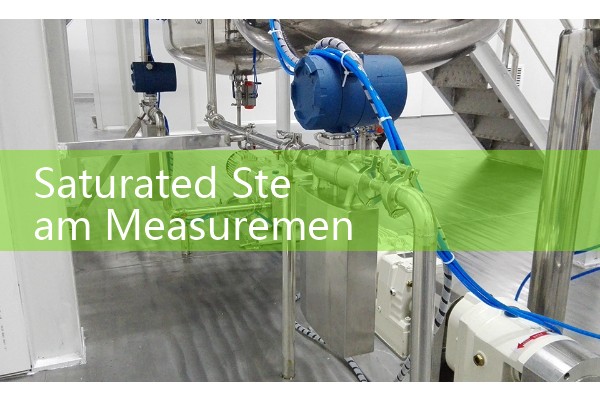
Straight pipe requirements are reasonable. Most installations need 15D upstream and 5D downstream when a flow conditioner is not used. That fits many boiler house layouts where space is tight. If you have a partially open gate valve right before the meter, add another 5D. We have seen customers in Nigeria mount a vortex meter right after a reducing elbow and then complain about noise. That is not a meter issue. That is an installation violation. Move the meter 20D downstream, and the signal cleans up.
What You Should Ask Before Buying a Steam Vortex Meter
Send us a few simple numbers, and we will propose the right model. Do not just send a general inquiry saying "need a steam flow meter price". That wastes time because we will ask you the same questions anyway.
Tell us your steam pressure (bar), steam temperature (°C), pipe size (DN), minimum and maximum flow rate (kg/h), and whether you need local display only or 4-20 mA HART output to a PLC or SCADA. If the location is outdoors in the Middle East or near a corrosive atmosphere in a chemical plant, mention that too. It changes the housing material choice. Silver Instruments supplies aluminum, 304 SS, and 316 SS housings, with IP67 or IP68 options. A water desalination plant in Oman ordered ten units in 316 SS with sun shields because of salt spray and direct sun.
For a standard saturated steam line at 8 bar, 175 °C, DN80 pipe, with 200 to 2000 kg/h flow, you can expect a vortex flow meter price from us that sits well below European brands but with the same feature set: built-in density compensation, HART 7, local LCD display, and a calibration certificate traceable to ISO 17025. Delivery takes 2 to 4 weeks by air freight to Lagos, Jakarta, Lima, or Dubai.
FAQ
Can a vortex flow meter handle wet steam with high condensate fraction?
A standard vortex meter is not designed for two-phase flow above about 5 percent liquid mass fraction. If your steam is heavily wet, install a separator and a steam trap upstream first. Then measure the drier steam. We can help size the separator if you give us the pipe diameter and the estimated condensate load in kg/h.
Do I need a flow computer with a multivariable vortex meter?
No. A multivariable vortex meter from Silver Instruments includes temperature and pressure sensors inside the body. The onboard electronics compute mass flow and output it directly as a single 4-20 mA signal with HART. You can also read the temperature and pressure as secondary HART variables if needed.
What is the typical accuracy for saturated steam measurement?
You can expect ±1.5 percent of rate for mass flow over a 10:1 turndown when the meter is installed with proper straight pipe and the steam stays in the saturated range. For custody transfer, some clients use ±1 percent of rate, which requires in-situ calibration with a master meter of the same fluid. That is feasible for larger DN150 and above lines.
How does vibration near the boiler affect the vortex signal?
Pipe vibration at frequencies overlapping the vortex range can cause zero-flow false readings or noise. Silver Instruments vortex meters use DSP filtering and spectral analysis to separate vibration noise from the true vortex frequency. In extreme cases, we recommend installing flexible pipe connectors or adding support brackets to mechanically isolate the meter. But the DSP handles most common boiler room vibration without issues.
Is a vortex meter better than an orifice plate for steam billing?
For steam billing between a utility plant and a tenant factory, a vortex meter seals the deal faster. There is no impulse line maintenance, no periodic orifice plate inspection, and less drift over time. The permanent pressure loss is lower than an orifice plate with the same beta ratio, which cuts the pump or boiler feed water energy cost. A textile park in Bangladesh switched from orifice DP meters to SVF series vortex meters two years ago and cut maintenance downtime by 70 percent.
Send us your pressure (bar), temperature (°C), pipe size (DN), and flow range (kg/h). We will reply within one business day with a fixed price quote and a GA drawing for your saturated steam line.